
Vanity Metrics and the Startup Community


Posted on:
Posted by:

Guest Post By Mital PatelTriangle Startup Weekend - (Co-Founder)

How Should We Measure Success In Our Startup Community?

TriangleStartupWeekend Vanity Metrics and the Startup Community

I’ve learned a lot in my 3 short years of organizing Triangle Startup Weekend (TSW). For one, you can get a lot done in 54 hours if you just focus on doing things rather than talking about what you plan to do. All of the Triangle Startup Weekends we’ve organized have been successes, each building on the previous and becoming a more efficient and impactful event for the startup community.

This past weekend, we hosted TSW EDU, North Carolina’s first Startup Weekend focused on spurring innovation and reform in the education space. Based on feedback from attendees, coaches, judges, sponsors, other organizers, and community members that followed along on Twitter, the event was a success. But how do we define success? Better yet, how should we define success?

How do we define success?

The first question I get after TSW usually relates to how many companies were formed or how many of the companies survived and are still operational businesses. How many got funding? How many are still around?

That’s understandable – it’s very human to think of the companies themselves as a measure for how successful TSW is at impacting our startup community. Don’t get me wrong, they’re definitely part of the equation. And there’s nothing worth hiding – both of the winners of TSW since 2011 are still around, operational, and joined by other companies that launched during TSW.

How should we define success?

I can tell you that after years of organizing TSW, the companies themselves are far from the most important measure of the event’s success. Just as website visits aren’t the best measure of success for a startup, the companies that form at TSW don’t tell the entire story worth telling.

When we tell people about what role TSW plays in the startup community, we start with the fact that it is one of the few events that engages the entire entrepreneurial stack. Brad Feld explains the importance of this engagement in Startup Communities and if he were to touch on the metrics that matter to a startup community in Startup Metrics, he would probably focus on more than just the companies that form out of Startup Weekends.

It’s common for attendees to meet future co-founders and find jobs. In fact, last year, one of our participants drove from Arkansas because his fiancée was starting graduate school in the Triangle and he needed a job. He walked away from the weekend with strong leads and found a job shortly thereafter.

One of TSW’s past mentors and judges, Richard White, CEO of UserVoice, came to TSW two years ago and points to the energy and engineering talent he saw as the sole reason he decided to open an engineering office in downtown Raleigh.

Scott Moody, founder of Authentec (recently acquired by Apple for $356 Million) often cites TSW as a factor in his decision to move from Florida to the Triangle.

It’s those types of things that we should be talking about when we talk about startup events.

Just as we have done (or should do) in our businesses, we should rethink how we measure success in our startup community and ask ourselves whether we’re using metrics that matter or merely vanity metrics.

Broadly, TSW EDU introduced entrepreneurship to educators, and education to entrepreneurs. It’s very likely the EdTech community in the Triangle will point back to TSW EDU as a tipping point. It’s too soon to measure all of the things that will come from TSW EDU, but I can tell you the companies that form from the weekend are just the tip of the iceberg. And they’re impressive enough in their own right.

 Vanity Metrics and the Startup Community

I’ve Been A Bad Feeder


Posted on:
Posted by:

Guest Post By Jesse AndersonNNSDG – (Founder)

Jesse Anderson Logo I’ve Been A Bad FeederI run a software developers group in Reno, NV called Northern Nevada Software Developers Group. Within the contexts of Startup Communities, our group acts as a feeder, but unfortunately we haven’t been as welcoming to entrepreneurs as we should have been.  Conversely, some of our guest entrepreneurs haven’t been as good at consuming our material as they could have been.  What follows are some observations and pointers to help make industry groups better feeders and entrepreneurs better users of such resources.

We get a wide range of entrepreneurs that attend our meetings.  Unfortunately the vast majority of these entrepreneurs only attend one meeting. During that meeting, they make a feverish pitch for their newly minted company which typically motivates one or two developers to get more information, but many pitches often result in no interest at all.

I didn’t quite know how to put this issue into words until I read Startup Communities.  The mantra of “give before you get” really applies to our situation and having entrepreneurs blow in and out after one session certainly doesn’t have any “give” to it.  In the group members’ and my view, most of entrepreneurs are only showing up to get a few warm bodies on a project.  They aren’t there to learn something or foster any sense of community. Meanwhile, I’m spending time, effort and money to engender a sense of community for developers and I want entrepreneurs to be a part of our ecosystem.

This pattern of “get before giving” has led me to be less accommodating to the entrepreneurs at our meetings.  In most situations I’ll allow them to do a short pitch, but I’m often not very encouraging of their ventures and am generally quite standoffish.  Over time this behavior stifled entrepreneurial interest and the experience has taught me that I need to be much more inclusive and welcoming to the entrepreneurs that attend our meetings, no matter their intentions.

I started inviting entrepreneurs to speak to our group in the hopes that it would help inspire more entrepreneurship both within the group and the community, but our meetings haven’t been well attended.  I think this bears out Startup Communities’ point that there are entrepreneurs, and then there’s everyone else.  I’ve come to understand that our role as a feeder is to encourage entrepreneurship and the commingling of professionals with entrepreneurs seeking talent.

My perception of the startup ecosystem has of course been colored by my own experiences.  Having been one of the first full-time employees of a local startup I know the trials and tribulations of working at a young company.  Long story short, the company failed and the experience didn’t exactly motivate me to want to join another early stage startup.  Since then I’ve often dissuaded others from joining startups in the hopes of saving them from having to experience the same end result. I’d like to believe that I’m protecting the group members, but I’ve learned that I need to let everyone make their own choices. The fact is, their individual startup experiences will ultimately differ greatly from my own.  So, if a group member wants to hear my stories, I’ll open up and tell them, but I’ve ceased trying to actively persuade them.

Expecting startups to fail is a failure on my part and is a perception I need to change.  It’s not easy to walk away from a failure you’re a part of and for a long time I was embarrassed about my own startup failure. Young startups fail all the time, many of them for reasons that are impossible to overcome, but in my case I felt I should have and could have done something about it. Becoming comfortable with the the natural life-cycle of the startup ecosystem is something I need to work on and attending various events like startup wakes, open coffee clubs and hackathons will hopefully put me on the right track.

Industry groups are an important part of the feeder ecosystem.  As a group, we can add a lot of value to our startup community, but in order to do so it’s vital that we check our preconceived notions at the door or we’ll never be the best feeders.

 I’ve Been A Bad Feeder

Event Rehash: Communitech


Posted on:
Posted by:

Guest Post By Anthony ReinhartCommunitech – (Writer)

Feld post Event Rehash: Communitech

(Photo: Anthony Reinhart)

It wasn’t a long time, but it was certainly a good time when Brad Feld dropped by the Communitech Hub Thursday.

Feld, the 47-year-old Foundry Group managing director, TechStars co-founder, author, marathoner and all-around good guy from Boulder, Colo., was on his first visit to Waterloo Region.

Over about six hours at the Communitech Hub, he toured the space, met entrepreneurs, spoke about how to build a great startup community and helped judge a sold-out Startup Smackdown before returning to Toronto for an early-morning flight out.

Feld left us with much to mull over and plenty to be proud about, which I’ll expand on here in due course. For now, I’ll leave you with what he told me at the end of a long day.

Q - So, what did you think of your day here?

A - I thought Communitech was awesome. I had a great day here.

I didn’t really know what to expect because I hadn’t been to Waterloo before, and I thought the community was extremely vibrant.

There’s a huge amount of people who are working on the right kinds of things, and the energy level is off the charts, which is really, really fun to see.

Q - Did anything in particular stand out from what you usually see in startup communities?

 A - I think the concentration of all of the different activities, including the accelerator, the university incubators, co-working space, event space, a bunch of entrepreneurs, the community space, is very powerful.

You see it in some other places, and it’s starting to appear in a more structured way in Chicago at 1871, or in D.C. at 1776, those two buildings. But this is a really mature example of it; it feels really built-out and not just well-organized, but extremely well-run.

It was nice to see, because I think there are a lot of people who aspire to have this at the core of their startup community, but it’s very hard to do, and it’s clear that this has been a lot of hard work over a number of years.

Q - So if you got home and (your wife) Amy asked, ‘How was Waterloo?’, what would you say?)

A - I’d say I had a great time.

I would tell her that I spent the entire time inside one building, so I didn’t really see Waterloo, but I saw Communitech, and I thought it was really cool.

 Event Rehash: Communitech

Philip Brown’s Review Of Do More Faster


Posted on:
Posted by:

Guest Post By Philip BrownYellow Flag - (Founder) 

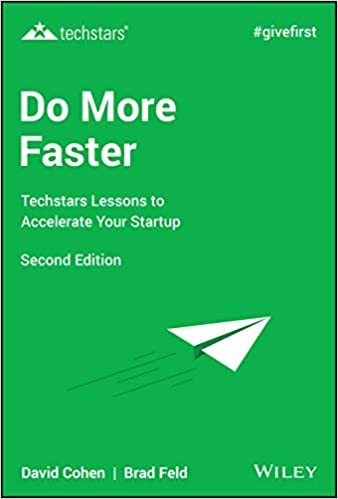
Do More Faster Philip Browns Review Of Do More Faster“Do More Faster: Lessons to accelerate your startup” is a book of advice and learnings that have derived from the technology accelerator program, TechStars. Do More Faster is written by TechStars founders David Cohen and Brad Feld and includes contributions from many of the mentors and past participants of the program.

TechStars in a mentorship accelerator program that started in Boulder, Colorado, but now has classes in Boston, New York and Seattle. Successful applicants take part in an intensive 3 month accelerator program where they get access to mentors in order to create successful companies. At the end of the program, the startups have the opportunity to pitch their company to Angel Investors and Venture Capitalists.

Do More Faster is based upon 7 themes of what it takes to start a successful company. Each theme contains lessons that mentors and previous TechStars participants have learned through their entrepreneurship endeavours.


The 7 themes of Do More Faster are:

  1. Idea and Vision
  2. People
  3. Execution
  4. Product
  5. Fundraising
  6. Legal and Structure
  7. Work-Life Balance

Idea and Vision

Part of the application process of TechStars is submitting an idea that the team will work on. This can either be a currently operational company, or merely just a vision for what is hoped to be achieved. In either case, TechStars accepts applicants based on the merits of the team, and not the idea.

It is this freedom to change ideas that allows TechStars participants to pivot into a completely different opportunity should the current assumptions reveal themselves to be wrong. This freedom enables a more iterative approach to finding a really big business opportunity.

A second common theme around ideas in TechStars is that ideas are worthless and execution can’t be copied. New entrepreneurs are often scared to share their idea in fear that someone copies them. The mentors of TechStars encourage participants to share their ideas with everyone in order to gain feedback and test their assumptions. Execution is really the most important aspect of creating a successful company. Even if someone else is working on the same idea, the execution of that idea will usually be quite different.

TechStars encourages applicants to get their ideas and products out into the open as quickly as possible, talk to customers and focus on the one thing that they can really do well to solve an important problem. All of these things can seem inherently difficult to first time entrepreneurs. By exposing an idea to the world, you gain feedback on it’s value and you are able to progress the opportunity quicker.

People

The second theme of Do More Faster is People and how it is the people that are involved in a company that really make the difference. TechStars is a mentorship driven programme and so it values the input of people within the community, mentors and fellow company founders.

The majority of TechStars companies are founded by at least two co-founders. Whilst it is possible to found a company as a single founder, it will require you to take on more work and stress if you choose to go it alone. A co-founder can not only do half the work, but she should also be a sounding board for ideas, advice and a comrade when the going gets tough.

The early employees of a company are really important for creating a good company culture. The culture of a company will usually originate from the actions and attitudes of the founders and early employees, so it is extremely important to choose the right sort of people who you want to work with. Skills and experience can always be taught over time, but a bad attitude will be like a cancer in your company. Many of the TechStars mentors advise to hire for culture and to hire slow and fire fast. If someone is not working out as an co-founder or an early employee you need to do something about it as soon as possible.

Execution

As mentioned in the Ideas and Vision theme, TechStars value a team’s ability to execute their plan. An idea is worthless without execution, and so the TechStars mentors push the participants to continuously and relentlessly execute their vision.

As the title of this book suggests, one of the mantras of TechStars is “Do more faster”. This does not mean reckless execution, but rather, creating a feedback loop to test and prove assumptions as quickly as possible. If a team can prove that an idea will not work, they can more quickly move onto an idea that will work. As a TechStars participant, you are encouraged to make decisions quickly, even when you don’t have all the information. A quick decision is usually better than a delayed decision, especially when the company is young.

Startups have a lot of disadvantages against established incumbents. Startups have no money, no customers, no partners and no leverage. However, Startups have nothing to lose and so they can take risks or focus on one precise opportunity without having to maintain legacy customers. If a Startup can’t take risks and move quickly with little information, they lose the one advantage they have over their established competitors.

During the 3 months of a TechStars program, each team will be getting a lot of different advice from some very experienced and respected mentors. TechStars teaches it’s teams to treat everything as data, and they should use their own synthesis of the various bits of data in order to make a value judgement on the future of their companies. This could mean completely neglecting the advice of a mentor, and instead, doubling down on an insight from a customer or a gut feeling.

Many of the lessons of TechStars can also be found in Steve Blank’s The Four Steps to the Epiphany and The Startup Owner’s Manual, or Eric Ries’ The Lean Startup.

Product

The product is obviously one of the most important aspects of a company because it is the product that becomes synonymous for Customers. Many Entrepreneurs will try to build a product from their vision or an assumption, when really, a product needs to be created for a market opportunity.

As mentioned above, TechStars teaches it’s participants to move quickly. TechStars companies are encouraged to get their product into the market as quickly as possible. Many founders will be scared to put out a product that is not finished, not polished or lacking in features. However, it is this scope creep that will handcuff the company from ever releasing the product. The quicker you get a feedback loop with your customer, the quicker you can achieve product-market fit. As the old saying goes, “If you are not ashamed of your first release of your product, you launched too late”.

Part of launching a product is dealing with either established or new competitors. Every good idea will have competitors in some form, even if they are not directly competing against you. It’s important to find your differentiation and to market yourself as a clear solution to a concrete problem. Going after the entire market is too big for any company, you must find a single customer cohort, and a single opportunity to attack first.

When you are excited about your product and you are starting to gain traction, it can be difficult to stay focused on the current goals of the company. Usually as a startup, you will have an assumption of a market opportunity that you should try to either prove right or wrong as quickly as possible. Along the way you will have business development deals, partnerships, and new possible market opportunities at every turn. It’s important to stay focused on completing the current goal of the company before starting to chase every opportunity. Working with large companies can be great for distribution, but the opportunity cost of neglecting your other goals can be worth even more.

Creating companies on the Internet has a huge advantage over traditional companies in that you have a wealth of data about every possible metric. You can accurately track your marketing and how every penny you spend converts into revenue. You can track how your product is being used, how it is growing, are your customers coming back, or are they getting stuck or confused on a certain aspect. None of this data is available to traditional companies. The wealth of data that is available can be overwhelming. It’s important to only track the things that are important to your product and your opportunity. Tracking the wrong metrics can be worse than doing no tracking at all.

Fundraising

Whilst fundraising is an important aspect in the lives of many of the startups that go through TechStars, each of the participants are encouraged to take a step back and question whether they actually need to raise money at all. Some of the most successful TechStars alumni are actually bootstrapped companies that took no investment at all once the program had concluded.

Raising money might seem like the natural next step, but it is actually not such an easy decision. When you take money from an investor, you are giving away part of your company and you lose at least some control. Investors are looking for a return on their investment and so they plan for a liquidity event at some point in your company’s future.

Bootstrapping a company can mean slower growth, but you retain full control over your company and you are not forced into a liquidity event.

Recently there have been many startups that raise money when they really don’t need to. Some companies are capital intensive, or it will naturally take a long time to get to cash-flow positive. These types of companies need to raise investment or they could never get off the ground. However, it’s highly unlikely that your Software as a Service startup needs to raise money to get started.

If you are looking to raise investment, taking part in a program like TechStars will make the process considerably easier. You will be introduced to the right type of investors through mentorship and you will be immersed in a community of people who you can ask questions and get the right type of advice. Fundraising is a full time job, and so anything you can do to smooth the process will be beneficial to your startup.

Legal and Structure

When you are starting a company, it’s important to remember the legal and structural implications of doing so. During the life of the company, you will be entering contracts, taking on debt, handing out credit and dealing with partners, customers and competitors. It is your responsibility to ensure that the legalities of your company are correct before taking further steps.

You should ensure that your company is recognised as the correct legal entity. Choosing the wrong structure could lead to personal liabilities should your company default or you become involved in a legal battle.

Your relationship with your co-founders should also be drafted in a legal document. Equity agreements, vesting schedule and Intellectual Property rights are important things to get right from the start.

Nobody starts a company with the expectation that something could go wrong, but it is your responsibility to take the correct precautions just in case. When you start a company with a co-founder, you expect to be both committed to the vision of the company. But outside events, or a change in personal circumstances can dramatically change things very quickly.

Despite a lack of money in the early stages of a company, you should invest in a startup lawyer who has a lot of experience of dealing with companies in your situation. General purpose lawyers won’t have the same expertise or guidance that a specific lawyer will have, and so it will mean you will have less problems further down the road when the legal agreements are actually needed.

Work-Life Balance

Starting a company from scratch can seem like a tremendous amount of work in the beginning as the future success of the company is entirely in your hands. Striking the right work-life balance is important because it is likely going to take years to really build a successful companies and so no-one can sustain an all work-lifestyle for that period of time.

It probably goes without saying that you should only start a company in an area that you are passionate about. When you naturally combine your interests with building a company it means you can dedicate more time to not only working on your company, but also acquiring knowledge of your domain.

But even still, it’s important to be able to escape the pressure and work-load that you are putting yourself under so you can continue making the right decisions for the future of your company.

Conclusion

Do More Faster is a fantastic book for anyone who is interested in building a startup. The book is comprised on many very short essays on lessons to learn. This make it very easy to read and to take actionable advice in very small chunks.

TechStars has become a world-renowned model for mentorship-driven entrepreneurship. If you are interested in applying for TechStars, or simply want to take the lessons and advice and apply them to your startup, Do More Faster is definitely worth your investment.

Buy Do More Faster: Lessons to accelerate your startup on Amazon (Affiliate link)

 Philip Browns Review Of Do More Faster

Balance and StartUp Life


Posted on:
Posted by:

Guest Post By Jeff BussgangFlybridge Capital Partners - (General Partner)

5 Balance and StartUp LifeLiving the startup life is a hard roller coaster.  One day you think you’re on the verge of building a billion-dollar company, the next you wake up in a cold sweat, paranoid that you are about to run out of cash and have to shut the whole thing down.

There a lot of good books on how to develop a customer value propositionrigorously test it and raise money.  But I have never seen a book address the hard issues of how to live your life while you’re working 80 hours a week trying to do all those things.  Until now.

My friend, Brad Feld, has written precisely that book with his wife Amy Batchelor, called Startup Life. The couple tackle how to manage your relationship with your significant other while trying to live in the mad, crazy, demanding world of startups.  Nothing is off limits for this book – Brad shares how he screwed up his first marriage, how they manage their highs and lows together and even addresses the topic of how to find time for sex while running a startup.

Brad asked me to share a few thoughts on my perspective on the topic and whether I had any additional tips.  I have been happily married for 19 years and have known my wife, Lynda, over 25 years (we met our first day freshman year in college while moving in to the same dormitory entryway).  Like Amy, Lynda is not in the startup world at all, but rather has a completely different work and personal profile than I do (she is a former professional Broadway-style performer and is now a pioneer in the world of aging and multi-generational programming).  Additional context:  we have three kids (now ages 16, 13 and 10).  Brad and Amy don’t have kids, so they were light on addressing this additional challenge – a topic I struggled with when I was an entrepreneur and still struggle with today as a multitasking, over-scheduled venture capitalist trying to be an accessible, loving Dad for my three high-energy children.

Be Predictable, Even If It’s Bad News.

One of the hardest things about being an entrepreneur is the unpredictable schedule you face.  A customer calls with a bug and there’s a crisis.  A new product needs to get pushed out the door and it’s a crisis.  Or you’re trying to raise money and you need to prepare all night for tomorrow’s investor meeting.  It would drive my wife absolutely nuts when I would say I would be home by a certain time, and then not show up until one or two hours later.  Dinner would be cold, kids would be mad and all hell would break loose.

I finally swore I’d get better at keeping track of time and setting expectations better with my wife about when I would come home.  So we developed a system together:  at the beginning of each month, I email her when to expect me home at night that month (or not at all if travelling) with a 15 minute range.  Many nights the range is “9:45-10:00pm” if I’m in NYC that day or have an evening event.  But it is what it is and I don’t try to sugarcoat it.  Then, I work very hard to stick to that hour, treating that deadline as if it were a meeting with an entrepreneur or a portfolio company board meeting.  If I know I am going to miss the deadline for being home (sure, stuff comes up), I always give her the heads up.  This creates a sense of predictability for her and the kids.

If I see my kids in the morning (which is rare, although I’m working on that), I will tell them verbally what time to expect me rather than try to hide from the fact that I’m travelling or working late that day.  This avoids my family getting more frustrated with my unpredictable schedule than my actual schedule!

You’re Just Not That Interesting.

In my early startup days, and the early days of the Internet, we used to refer to the crazy pace that we were living as “Internet Time”.  There was this feeling that everyone else was living a slower pace than we were.  Indeed, to me, my 12-14 hour work day was chock full of a week’s worth of stories, characters and drama.  Subconsciously, I thought my day-to-day was more exciting than my wife’s and would come home eager to share all the drama.  After a few years, I began to realize that as interesting and dramatic as my work life is to me, it’s really not that interesting to Lynda.  She cares about the big things, of course, and she cares about how I’m feeling about it, but the ups and downs about new product releases and who’s missing the quarter and what competitors are doing are all just noise to her.

So my mantra now is, my work life just isn’t that interesting to my family.  I share with them the top-line highs and lows, but I don’t think my wife could name each of my portfolio companies.  Instead, when I come home, I focus on them:  the ups and downs of my kids social and academic lives; the ups and downs of my wife’s work and social life.  In my head, I try to keep it to “80% them, 20% me” sharing time.  I’m sure it ends up more balanced, but if I aim for 20%, I know I’ll come home focused on them rather than on me.  To be clear, I love my work and love being consumed in it.  It’s just not that interesting to the four other members of my household.  And I’m ok with that.

Find Together Projects.

My wife and I operate in different professional worlds, but we have found that we love collaborating together on projects beyond the raising of our three kids.  Raising our kids takes an enormous amount of thought and energy.  The topic of our children often dominates our private time together.  We have discussions and make decisions each week about their activities, their school work, who is to have a sleepover, who is picking them up when (during the weekend, we often switch to “taxi driver” mode) and what they should do for the summer.  But, we have found that having “adult projects” that we collaborate on is also very rewarding.  We have pored energy into various non-profitsour synagogue and our kids’ schools as a way of making a difference, yes, but also spending our outside work time together.  Thus, although our professional communities are very separate, our personal and social communities are totally integrated.

In addition to those few tips and reading Amy and Brad’s books, I recommend a few other books:

  • The Three Big Questions For a Frantic Family by Patrick Lencioni.  Lencioni is one of my favorite business book writers (see this blog post on his work on team dysfunction) and so this book was a refreshing way to apply some of his core business lessons to family management.
  • Raising Cain by Daniel Kindon and Michael Thompson.  I have two boys.  I have read this book twice – once when they were recently born and again recently as they move into the world of teenagers and found both sessions incredibly helpful and informative.
  • Nurture Shock: New Thinking About Children by Po Bronson and Ashley Merryman.  David Kidder of Clickale suggested this one to me and I have enjoyed it as a book that cuts against conventional wisdom in many areas of raising children.
  • The Talent Code:  Greatness Isn’t Born, It’s Grown. Here’s How by Daniel Coyle.  My partner Jon Karlen recommended this one to me.  Jon was an all-American squash player and his wife was a 12-letter athlete (!) at Harvard, so I take his recommendations about raising talented kids seriously!

Good luck with your own journey for balance and happiness!

This is a re-post from Jeff’s blog Seeing Both Sides

 Balance and StartUp Life

Sex And Money! Do I Have Your Attention?


Posted on:
Posted by:

Guest Post By Ilana KatzThe Underground” – (Author)

Ilana Katz Sex And Money! Do I Have Your Attention?I can’t think of two topics that are bigger hot buttons, not just for entrepreneurs, but for an awful lot of people. I have no doubt that many of you have opinions and experiences about sex and money that aren’t aligned with your partners.

You certainly aren’t alone!

When Brad and Amy, who we’ve known for 25 years, asked me and my husband, Warren, to write about these very personal topics, it was not by accident. They’ve known the ups and downs of our marriage and watched us go through marital trials that not everyone emerges from in-tact.

I initially felt afraid to reveal our tangles with these private issues, but my next quick thought trumped my fears. I knew that sharing our experiences – in a meaningful way – could really help others. Navigating these delicate waters of being in relationships with entrepreneurs is no picnic. Understanding the way my entrepreneurial partner ticked, and letting him understand what worked for me and what didn’t, was paramount to our relationship lasting.

The Startup Life book covers a plethora of topics. The honest and practical no-nonsense essays from a variety of entrepreneurs and their partners offer unique windows to  how others have solved or learned from familiar situations. At the very least, it offers fodder for discussions that might otherwise be difficult to broach. Working through challenges, or even approaching something before it becomes an insurmountable is one of the benefits this title offers.

Heck, you can always say to your partner: “hey, read these ten pages and then come find me.”

I would have loved to have this book when my husband (then, boyfriend) started his company. I’m certain our relationship would have benefited from the road map of Startup Life. To draw from experiences of like-minded people would have been invaluable. Instead we stumbled, sometimes rather badly, through some pretty dark places as a couple.

No regrets! With just weeks until my 20th wedding anniversary, we’re stronger than ever and have decided to give it another twenty years and see if it sticks!  J

Ilana Katz  is the author of “The Underground” – a dystopian novel. When not writing, Ilana entertains in Boston’s subways, playing old-time and blues fiddle. www.ilanakatz.com

 Sex And Money! Do I Have Your Attention?

Startup Life: Book Review in Forbes


Posted on:
Posted by:

 I am delighted to share a thoughtful and positive review of Startup Life in Forbes online by Brent Beshore entitled “7 Changes for Your “Startup Life.’”  Click here to read the review. 

 According to Brent, “If you are an entrepreneur, are thinking of becoming one, or are in a relationship with one, I would highly suggest you buy “Startup Life: Surviving and Thriving in a Relationship With an Entrepreneur.” At the very least, it will give you an inside look at a highly successful long-term relationship that has endured through virtually every cycle of entrepreneurial living. Or, it just might change the way you do life.”  Thanks for the kind words, Brent!

Brad and I have been overwhelmed by the positive response to the book, and hope that entrepreneurial couples are enjoying the conversations Startup Life is sparking.

This post originally appeared on Thoughts in Random Patterns by Amy Batchelor. 

 Startup Life: Book Review in Forbes

Who Ever Said There’s No Such Thing As a Free Lunch?


Posted on:
Posted by:

Guest Post By Danny Beckett JrFree Lunch Friday (Co-Founder)

 Who Ever Said Theres No Such Thing As a Free Lunch?Several years ago in a small community in the Midwest, I decided to invite the startups and entrepreneurs out for some free food, beer, and community at my office.

This was my way of bringing together the local startups and entrepreneurs to say thank you for the work and hustle that they put into building their companies day in and day out. A way for me to say thank you for your sacrifices, thank you for your time and unrelenting energy, thank you for creating jobs and opportunities. And thank you for feeding our local economy and the mouths of our citizens.

Why?  This was how I was raised - to take care of the people who take care of you. And why not do it over good food, good people, and few hungry startups and entrepreneurs?

This small act of bringing everyone together turned into FLF (Free Lunch Friday) where we would gather on the last Friday of every month.

What started out as just 25 people getting together eventually grew into monthly event with over 200 people in attendance. As FLF grew we added various content and programming elements such as: speakers, local bands, holiday events, and more.

People would look forward to FLF every month – it became the hub within the community for startups and entrepreneurs to gather.

Years later after watching so many lose jobs and people try to come up another plan to fix our economies, I figured let’s get back to the basics of people and community. Let’s take a small idea and turn it into a vision that will impact the world.

Welcome to FLF! Free Lunch Friday (FLF) is a non-profit built to provide community, content, connections and access to capital to the hungry startups and entrepreneurs who drive our global economies. We are here to inspire, educate, and empower.

Our vision at FLF is to create a global community of hungry startups and entrepreneurs working together to build incredible companies that drive our economies forward, provide jobs, and change the world.

Our mission is to feed the startups and entrepreneurs that feed our global economies.

When we say feed the startups and entrepreneurs that feed our global economies, we literally mean that we will feed them. At FLF locations around the world startups and entrepreneurs will gather on the last Friday of every month for free food, beer, and community. We will also produce FLF talks at each location that get edited and pushed out to www.thefreelunchfriday.com, for free – think TED on sterooids plus free food, beer, and entrepreneurs!

We are not just another event with a speaker charging you 30 dollars, we are not an advocacy campaign, and we are not another government agency with an agenda. We are serious entrepreneurs who are hungry to make things happen. By partnering with local startup ecosystems and global startup organizations, we feel we can help create a comprehensive support system for startups.  We are on the ground, we are in the trenches, and we want to work with you to launch FLF locations around the world.

Our first FLF locations will launch on Jan 25th in LA, DC, and Detroit. To see a map of planned FLF locations for 2013 please go to www.thefreelunchfriday.com and click on a location to learn more. If you do not see a location please contact us to consider a location in your community.

You can also sign up to be an FLF leader, a speaker, or just be a part of the community. It really takes a variety of people and roles to make it all work.

How about you? Hungry? Thirsty? Seeking community? Join the FLF community of startups and entrepreneurs and help us change the world.

What do you say we get started.

Stay hungry!

www.thefreelunchfriday.com

 Who Ever Said Theres No Such Thing As a Free Lunch?

How Angels Without Tech Experience Can Vet Tech Companies


Posted on:
Posted by:

Q:  My partner at Roaring Fork, Lee Lemon, is based out of Fort Wayne, IN where he is helping promote a startup community.  There are many potential angel investors Lee knows in the area (some quite significant), but most of their experience comes from manufacturing, real estate, and some medical.  They want to invest in tech, but feel they just don’t have the expertise to vet opportunities in that sector. How can the tech community help these angels?

One of the powerful things about startup communities that embrace the philosophy of “give before you get” is how easily n0n-tech angel investors can  engage with tech related entrepreneurs. If the tech-related entrepreneurs recognize that they will help expand the startup community by helping the angel investors understand what and how they should invest in, magic can happen.

Here’s the way it works. You’ve got a bunch of wealthy business people who made money in non-tech businesses. They are excited about investing in tech-related companies, but they have no idea how to evaluate things. Several of the local tech entrepreneurs, who have both experience and resources to invest, can start leading the charge on a few tech-related angel investments. They hold their hands up to help evaluate the companies for the non-tech angels, and commit to investing their own money, even if it’s a modest amount ($5k or $10k per deal is fine), in the companies they choose.

More importantly, the tech-related entrepreneurs now turned angels do not take anything additional – either equity, fees, or an expectation of any quid pro quo – from the non-tech angels. This is the key – the tech entrepreneurs have to build trust and community with the non-tech angels. So they should be completely aligned financially, and playing a long-term game of getting more non-tech angels into the mix. This is give before you get at its core – you are “giving your time, energy, and credibility” with an effort to increase the size of the angel community, which will increase the startup community, which will pay off in the future in many ways.

 How Angels Without Tech Experience Can Vet Tech Companies