
Startup Genealogy


Posted on:
Posted by:

Family tree Startup Genealogy We’re beginning to see an interesting phenomenon occur with the success of Startup Communities. Readers are extrapolating the lessons within the book and are raising some interesting questions about the drivers, best practices and key components of startup communities. Recently, Dan Moore, a local Boulder IT consultant, wrote a blog post questioning the lasting impact the personnel of a former employer had on the local startup community. His blog post raises an interesting question.

How many startups have been birthed as a result of personnel from a former startup?

In his own case, Mr. Moore was an employee of XOR, (Internet technology, Systems, IT) and according to his experience some 23 companies were formed as an off fall of its sale, one of which includes the company he currently works for. This information has spurred the team here at Startup Revolution to wonder if we could put together a data set that would depict the general impact startups have on their communities.

So we decided to begin the process of sourcing information regarding such matters and are now putting together a data set on the long term residual effects of startups; no matter their outcome. Whether they failed or succeeded we want to know the impact startups have.

So we’ve got a favor to ask…we need you to fill out the form below providing us with important information on the number of companies that were spun off as a result of either the sale or closing up of a former employer.

Simply fill out and submit the form below and we’ll start building the data set.

Thanks for all the help!

-The Startup Revolution Team


Startup Genealogy Submission

Fields marked with a * are required
 Startup Genealogy

The Kentucky Thesis


Posted on:
Posted by:

Guest Post By Kent OylerOPM Financial – (President)

OPM Financial Logo The Kentucky ThesisNot long ago the guys from Awesome Inc arranged for startup guru Brad Feld to speak at the Kentucky Center about the Boulder, Colo., startup phenomenon. Somehow Boulder has attained the mythical entrepreneurial status we also attribute to Austin, the San Francisco Bay Area and Research Triangle.

Now back in the post-Nam days, when I was a longer-haired undergrad at CU-Boulder, the only local entrepreneurs I can recall utilized baggies to distribute their product. Gnarly for sure, but definitely not a global hot spot.

So, I wondered, what changed since the late ’70s, besides the merciful death of disco? How had the most liberal college town in America transformed itself into one of the preeminent entrepreneurial communities in the world and a birthplace of TechStars?

Maybe Feld’s speech would provide some answers, so I bought a ticket (and later, his book).

From Boulder to Louisville

In Feld’s TED-style talk, he used a flip chart to quickly lay out what he calls the “Boulder Thesis” (which he stretches to 200 pages in his book, Startup Communities). In short, Feld’s Boulder Thesis states that a vibrant entrepreneurial community must:

  1. Be led by entrepreneurs who
  2. Have a long-term commitment, and
  3. Be inclusive of anyone who wants to participate in it, and
  4. Continually engage the entire entrepreneurial stack.

Understand that Boulder, which is fondly referred to as “eight square miles surrounded by reality,” sports five major research labs and the most degreed population in the United States. So it’s a pseudo-Oz, and whatever they do or (now legally) smoke out there might not translate to Kentucky.

OPM Financial The Kentucky ThesisBut what if it does? What if our most ambitious people self-organized into the best job and wealth creation machine this side of the Rockies?

I’m here to proclaim that the soul of the Boulder Thesis is, indeed, beginning to trend right here in the Bluegrass. Granted, we don’t yet match their 2013 Rockin’ Mountain High community, but (cue Journey) we are at least in the ’80s, or maybe even (fade to Pearl Jam) the ’90s in Boulder time, edging ever closer to the so-2009 Black Eyed Peas’ “I Got A Feeling.” (Way to remix those metaphors.) 

My point is that this region is slowly but surely crafting its own energetic entrepreneurial community under flag bearers such as Phoebe Wood, Doug Cobb, Bob Saunders, Kimberly Nasief-Westergren, David Jones, Charlie Moyer, Tendai Charasika, Mark Crane, Greg Fischer, Adam Fish, Alex Frommeyer, Kris Kimel, Brian Raney, Suzanne Bergmeister and many others.

This isn’t a planned and managed affair; it’s organic and authentic. It’s like cat herding. It’s highly inclusive and spans the “stack” from investors to entrepreneurs to supporters. It includes long-standing groups such as Venture Connectors, KSTC, Nucleus and Enterprise Corp.; alongside rogues like Forge and Startup Weekend.

With the Gil Holland-led re-entrepreneurization of NuLu, the community even has a homeland.

From Louisville to the Commonwealth

To paraphrase Brad Feld, we are witnessing the birth of not just the Louisville Thesis, but the Kentucky Thesis, which I might point out is miraculously overcoming basketball rivalries and connecting with like-minded clusters of entrepreneurial diasporas from Paducah to Lexington to Covington.

A good thing? I damn well think so, and cheer on all comers who are willing to pitch in, whether by starting a company, investing, working, sponsoring or just showing up. We don’t have to become Boulder.Who needs weed dispensaries and 300 days of sunshine anyway? We just need to be ourselves and stick with it.

We have strengths in logistics, healthcare, food and manufacturing combined with that bull-headed Kentucky long-rifle sense of independence – hey, not every region is so blessed. We have plenty of bright people and ideas. And nobody sees us coming.

Granted, it was probably a hair easier to grow a vibrant entrepreneurial community in progressive, highly educated, uber-cool Boulder. But when we do it here, Mr. Feld will have an even better book to write.

Or maybe we’ll just write it ourselves.

 The Kentucky Thesis

Event Rehash: Communitech


Posted on:
Posted by:

Guest Post By Anthony ReinhartCommunitech – (Writer)

Feld post Event Rehash: Communitech

(Photo: Anthony Reinhart)

It wasn’t a long time, but it was certainly a good time when Brad Feld dropped by the Communitech Hub Thursday.

Feld, the 47-year-old Foundry Group managing director, TechStars co-founder, author, marathoner and all-around good guy from Boulder, Colo., was on his first visit to Waterloo Region.

Over about six hours at the Communitech Hub, he toured the space, met entrepreneurs, spoke about how to build a great startup community and helped judge a sold-out Startup Smackdown before returning to Toronto for an early-morning flight out.

Feld left us with much to mull over and plenty to be proud about, which I’ll expand on here in due course. For now, I’ll leave you with what he told me at the end of a long day.

Q - So, what did you think of your day here?

A - I thought Communitech was awesome. I had a great day here.

I didn’t really know what to expect because I hadn’t been to Waterloo before, and I thought the community was extremely vibrant.

There’s a huge amount of people who are working on the right kinds of things, and the energy level is off the charts, which is really, really fun to see.

Q - Did anything in particular stand out from what you usually see in startup communities?

 A - I think the concentration of all of the different activities, including the accelerator, the university incubators, co-working space, event space, a bunch of entrepreneurs, the community space, is very powerful.

You see it in some other places, and it’s starting to appear in a more structured way in Chicago at 1871, or in D.C. at 1776, those two buildings. But this is a really mature example of it; it feels really built-out and not just well-organized, but extremely well-run.

It was nice to see, because I think there are a lot of people who aspire to have this at the core of their startup community, but it’s very hard to do, and it’s clear that this has been a lot of hard work over a number of years.

Q - So if you got home and (your wife) Amy asked, ‘How was Waterloo?’, what would you say?)

A - I’d say I had a great time.

I would tell her that I spent the entire time inside one building, so I didn’t really see Waterloo, but I saw Communitech, and I thought it was really cool.

 Event Rehash: Communitech

Public Events for 2/25/2013 – 3/3/2013


Posted on:
Posted by:

INcubes Logo Public Events for 2/25/2013   3/3/2013   Register: N/A

[IN]cubes Demo Day: Live Broadcast
When: Wed, February 27th, 2013 @ 1pm
Where: Toronto, Ontario.
Description: Although physically closed to the public, Itbusiness.ca will be broadcasting the event live. Tune in to hear Brad Feld’s Keynote speech.

Communitech logo Public Events for 2/25/2013   3/3/2013    Register
Startup Communities with Brad Feld
When: Thurs, February 28th, 2013 @ 4:30-5:30pm
Where: Tannery Event Center, 151 Charles Street West – Kitchener, Ontario
Description: Join us to hear Brad Feld talk!
The Boulder Thesis: Four Principles for Startup Communities.
Read More

Communitech logo Public Events for 2/25/2013   3/3/2013    Register
Startup Smackdown
When: Thurs, February 28th, 2013 @ 6:30-8:30pm
Where: Tannery Event Center, 151 Charles Street West – Kitchener, Ontario
Description: Startup Smackdown is a fast pitch competition, where 10 startups are called to the ring to pitch in front of a panel of judges.
Read More

Think Big Arkansas Public Events for 2/25/2013   3/3/2013  Register

ThinkBig Arkansas
When: Fri March 1st, 2013 @8:00am-8:00pm
Where: Student Life & Technology Center – Worsham Ballroom Hendrix College - Conway, Arkansas
Description: Join us Friday, March1, 2013 at Hendrix College in Conway for an open discussion on building the state’s entrepreneurial and startup ecosystem.
Read More

  *Brad talks at 6:30pm Central


 Public Events for 2/25/2013   3/3/2013

Philip Brown’s Review Of Do More Faster


Posted on:
Posted by:

Guest Post By Philip BrownYellow Flag - (Founder) 

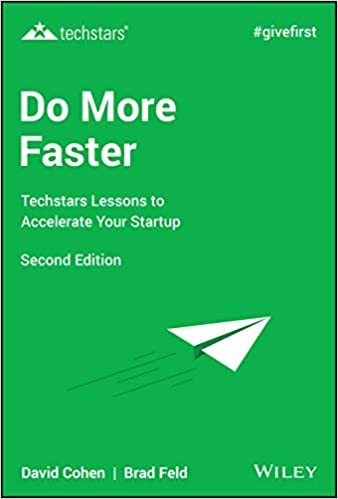
Do More Faster Philip Browns Review Of Do More Faster“Do More Faster: Lessons to accelerate your startup” is a book of advice and learnings that have derived from the technology accelerator program, TechStars. Do More Faster is written by TechStars founders David Cohen and Brad Feld and includes contributions from many of the mentors and past participants of the program.

TechStars in a mentorship accelerator program that started in Boulder, Colorado, but now has classes in Boston, New York and Seattle. Successful applicants take part in an intensive 3 month accelerator program where they get access to mentors in order to create successful companies. At the end of the program, the startups have the opportunity to pitch their company to Angel Investors and Venture Capitalists.

Do More Faster is based upon 7 themes of what it takes to start a successful company. Each theme contains lessons that mentors and previous TechStars participants have learned through their entrepreneurship endeavours.


The 7 themes of Do More Faster are:

  1. Idea and Vision
  2. People
  3. Execution
  4. Product
  5. Fundraising
  6. Legal and Structure
  7. Work-Life Balance

Idea and Vision

Part of the application process of TechStars is submitting an idea that the team will work on. This can either be a currently operational company, or merely just a vision for what is hoped to be achieved. In either case, TechStars accepts applicants based on the merits of the team, and not the idea.

It is this freedom to change ideas that allows TechStars participants to pivot into a completely different opportunity should the current assumptions reveal themselves to be wrong. This freedom enables a more iterative approach to finding a really big business opportunity.

A second common theme around ideas in TechStars is that ideas are worthless and execution can’t be copied. New entrepreneurs are often scared to share their idea in fear that someone copies them. The mentors of TechStars encourage participants to share their ideas with everyone in order to gain feedback and test their assumptions. Execution is really the most important aspect of creating a successful company. Even if someone else is working on the same idea, the execution of that idea will usually be quite different.

TechStars encourages applicants to get their ideas and products out into the open as quickly as possible, talk to customers and focus on the one thing that they can really do well to solve an important problem. All of these things can seem inherently difficult to first time entrepreneurs. By exposing an idea to the world, you gain feedback on it’s value and you are able to progress the opportunity quicker.

People

The second theme of Do More Faster is People and how it is the people that are involved in a company that really make the difference. TechStars is a mentorship driven programme and so it values the input of people within the community, mentors and fellow company founders.

The majority of TechStars companies are founded by at least two co-founders. Whilst it is possible to found a company as a single founder, it will require you to take on more work and stress if you choose to go it alone. A co-founder can not only do half the work, but she should also be a sounding board for ideas, advice and a comrade when the going gets tough.

The early employees of a company are really important for creating a good company culture. The culture of a company will usually originate from the actions and attitudes of the founders and early employees, so it is extremely important to choose the right sort of people who you want to work with. Skills and experience can always be taught over time, but a bad attitude will be like a cancer in your company. Many of the TechStars mentors advise to hire for culture and to hire slow and fire fast. If someone is not working out as an co-founder or an early employee you need to do something about it as soon as possible.

Execution

As mentioned in the Ideas and Vision theme, TechStars value a team’s ability to execute their plan. An idea is worthless without execution, and so the TechStars mentors push the participants to continuously and relentlessly execute their vision.

As the title of this book suggests, one of the mantras of TechStars is “Do more faster”. This does not mean reckless execution, but rather, creating a feedback loop to test and prove assumptions as quickly as possible. If a team can prove that an idea will not work, they can more quickly move onto an idea that will work. As a TechStars participant, you are encouraged to make decisions quickly, even when you don’t have all the information. A quick decision is usually better than a delayed decision, especially when the company is young.

Startups have a lot of disadvantages against established incumbents. Startups have no money, no customers, no partners and no leverage. However, Startups have nothing to lose and so they can take risks or focus on one precise opportunity without having to maintain legacy customers. If a Startup can’t take risks and move quickly with little information, they lose the one advantage they have over their established competitors.

During the 3 months of a TechStars program, each team will be getting a lot of different advice from some very experienced and respected mentors. TechStars teaches it’s teams to treat everything as data, and they should use their own synthesis of the various bits of data in order to make a value judgement on the future of their companies. This could mean completely neglecting the advice of a mentor, and instead, doubling down on an insight from a customer or a gut feeling.

Many of the lessons of TechStars can also be found in Steve Blank’s The Four Steps to the Epiphany and The Startup Owner’s Manual, or Eric Ries’ The Lean Startup.

Product

The product is obviously one of the most important aspects of a company because it is the product that becomes synonymous for Customers. Many Entrepreneurs will try to build a product from their vision or an assumption, when really, a product needs to be created for a market opportunity.

As mentioned above, TechStars teaches it’s participants to move quickly. TechStars companies are encouraged to get their product into the market as quickly as possible. Many founders will be scared to put out a product that is not finished, not polished or lacking in features. However, it is this scope creep that will handcuff the company from ever releasing the product. The quicker you get a feedback loop with your customer, the quicker you can achieve product-market fit. As the old saying goes, “If you are not ashamed of your first release of your product, you launched too late”.

Part of launching a product is dealing with either established or new competitors. Every good idea will have competitors in some form, even if they are not directly competing against you. It’s important to find your differentiation and to market yourself as a clear solution to a concrete problem. Going after the entire market is too big for any company, you must find a single customer cohort, and a single opportunity to attack first.

When you are excited about your product and you are starting to gain traction, it can be difficult to stay focused on the current goals of the company. Usually as a startup, you will have an assumption of a market opportunity that you should try to either prove right or wrong as quickly as possible. Along the way you will have business development deals, partnerships, and new possible market opportunities at every turn. It’s important to stay focused on completing the current goal of the company before starting to chase every opportunity. Working with large companies can be great for distribution, but the opportunity cost of neglecting your other goals can be worth even more.

Creating companies on the Internet has a huge advantage over traditional companies in that you have a wealth of data about every possible metric. You can accurately track your marketing and how every penny you spend converts into revenue. You can track how your product is being used, how it is growing, are your customers coming back, or are they getting stuck or confused on a certain aspect. None of this data is available to traditional companies. The wealth of data that is available can be overwhelming. It’s important to only track the things that are important to your product and your opportunity. Tracking the wrong metrics can be worse than doing no tracking at all.

Fundraising

Whilst fundraising is an important aspect in the lives of many of the startups that go through TechStars, each of the participants are encouraged to take a step back and question whether they actually need to raise money at all. Some of the most successful TechStars alumni are actually bootstrapped companies that took no investment at all once the program had concluded.

Raising money might seem like the natural next step, but it is actually not such an easy decision. When you take money from an investor, you are giving away part of your company and you lose at least some control. Investors are looking for a return on their investment and so they plan for a liquidity event at some point in your company’s future.

Bootstrapping a company can mean slower growth, but you retain full control over your company and you are not forced into a liquidity event.

Recently there have been many startups that raise money when they really don’t need to. Some companies are capital intensive, or it will naturally take a long time to get to cash-flow positive. These types of companies need to raise investment or they could never get off the ground. However, it’s highly unlikely that your Software as a Service startup needs to raise money to get started.

If you are looking to raise investment, taking part in a program like TechStars will make the process considerably easier. You will be introduced to the right type of investors through mentorship and you will be immersed in a community of people who you can ask questions and get the right type of advice. Fundraising is a full time job, and so anything you can do to smooth the process will be beneficial to your startup.

Legal and Structure

When you are starting a company, it’s important to remember the legal and structural implications of doing so. During the life of the company, you will be entering contracts, taking on debt, handing out credit and dealing with partners, customers and competitors. It is your responsibility to ensure that the legalities of your company are correct before taking further steps.

You should ensure that your company is recognised as the correct legal entity. Choosing the wrong structure could lead to personal liabilities should your company default or you become involved in a legal battle.

Your relationship with your co-founders should also be drafted in a legal document. Equity agreements, vesting schedule and Intellectual Property rights are important things to get right from the start.

Nobody starts a company with the expectation that something could go wrong, but it is your responsibility to take the correct precautions just in case. When you start a company with a co-founder, you expect to be both committed to the vision of the company. But outside events, or a change in personal circumstances can dramatically change things very quickly.

Despite a lack of money in the early stages of a company, you should invest in a startup lawyer who has a lot of experience of dealing with companies in your situation. General purpose lawyers won’t have the same expertise or guidance that a specific lawyer will have, and so it will mean you will have less problems further down the road when the legal agreements are actually needed.

Work-Life Balance

Starting a company from scratch can seem like a tremendous amount of work in the beginning as the future success of the company is entirely in your hands. Striking the right work-life balance is important because it is likely going to take years to really build a successful companies and so no-one can sustain an all work-lifestyle for that period of time.

It probably goes without saying that you should only start a company in an area that you are passionate about. When you naturally combine your interests with building a company it means you can dedicate more time to not only working on your company, but also acquiring knowledge of your domain.

But even still, it’s important to be able to escape the pressure and work-load that you are putting yourself under so you can continue making the right decisions for the future of your company.

Conclusion

Do More Faster is a fantastic book for anyone who is interested in building a startup. The book is comprised on many very short essays on lessons to learn. This make it very easy to read and to take actionable advice in very small chunks.

TechStars has become a world-renowned model for mentorship-driven entrepreneurship. If you are interested in applying for TechStars, or simply want to take the lessons and advice and apply them to your startup, Do More Faster is definitely worth your investment.

Buy Do More Faster: Lessons to accelerate your startup on Amazon (Affiliate link)

 Philip Browns Review Of Do More Faster

Sister Startup Communities


Posted on:
Posted by:

Guest Post By: Jeff Keen – Accelerate Okanagan (CEO)

I heard so much about the incredible Startup Community developing in Boulder that I decided to take a trip there to witness it firsthand.  Since my return, many people have asked about the trip, about Boulder and our experience.  For those of you who like to cook, you could draw a parallel of my Boulder visit to reading a cookbook versus taking a hands on cooking class from world class chefs. The intended results are the same but there is nothing quite like being there, witnessing how it’s done, and immersing yourself in the culture to truly appreciate and get the most from the experience.

During our visit, we had the opportunity to meet with many community leaders and learn about the evolution of Boulder as a Startup Community.  Everyone is actively involved and committed to making a difference.  We had 12 meetings in just over 2 days, each starting and ending the same way “how can I help?” and “is there anything else I can do to help or people you would like to meet?”  Awesome.

We participated in Meet-up events, Entrepreneurs Unplugged at CU Boulder and were invited to a small group dinner with community leaders and entrepreneurs.  We visited Techstars, were welcomed into several co-working spaces to hangout and catch-up on emails.  We were the beneficiary of many pay-it-forward introductions – no questions asked.  Entrepreneurs are everywhere in Boulder and the entrepreneurial energy is infectious. One afternoon at a local establishment, our server asked why we were in town and then proceeded to spend the next 30 minutes talking to us about her Startup.  Sidebar: Another great experience during our visit was the prevalence of “Happy Hour”. For a beer loving Canadian entrepreneur could Boulder be any more perfect?

If you read Brad Felds book “Startup Communities”, he talks about the Entrepreneurial eco system and the importance of it being led by entrepreneurs, the ”give before you get” attitude,  network versus hierarchical structure, inclusive of all who want to be involved and the necessity to be in it for the long term – 20 years from any point in time.  There are many other important discussions in the book, but these were my key impressions and our firsthand experience in Boulder.

The only negative about our Boulder visit was that it ended too soon. It was very inspiring and motivating to hang with people that are all working together to make a difference, led by entrepreneurs and supported by the community – everybody “all in”. Cool.

On the trip back, I was thinking about our experience in Boulder.  How could we tap into that culture, the infectious energy and continue to learn about successful Startup communities on a go forward basis?  The concept of the Entrepreneurial eco-system being a network not a hierarchy was resonating with me – the power is in the network.  Could we expand the network and get entrepreneurs connected to and from other regions? Perhaps we create a “Startup Communities Network”, a network of like minded entrepreneurs from other communities committed to the ”give before you get” culture – the impact could be very powerful; entrepreneurs helping entrepreneurs through a boundless, non-regionalized support system, making the right connections at the right time, reducing risk and accelerating business growth.

Interested in discussing the “Startup Communities Network” concept in more detail?  I look forward to your feedback and getting connected.

A big shout out to Brad Feld and all the amazing people from Boulder for making us feel welcome and for sharing your time and experiences with us.  We are returning to the Okanagan with many great community building ideas to share and look forward to visiting Boulder again in the near future!

 Sister Startup Communities

Part I: The Start-up of Russia. The Startup of Start-up Communities: The Power of Clones in Russia—& Beyond


Posted on:
Posted by:

Guest Post By Tom NastasScaling up Innovation – (VC, Mentor, Blogger)

Tom Nastas a 25 year VC veteran in US, int’l and emerging markets wrote a series for Startup Rev on the ‘spark’ which sparked the startup of Russia and how the development of start-up communities in emerging markets are shaped much more by the cultures of risk vs. what we investors and entrepreneurs face in the USA. An interesting read, below are the individual posts and content for each one.

Last time I introduced the questions as topics for answers in this five part post series:

1.)   What is the ‘spark’ that ignites the startup of start-up communities?
2.)   How does the ‘start-up’ of startup communities differ—emerging markets vs. developed countries?
3.)   Why is the US entrepreneurial model of experimentation, trial and error and pivoting a death sentence for entrepreneurs in the emerging markets? And what you can do about it.
4.)   How does the culture of risk and failure in emerging markets impact investor DNA—what they finance and what they won’t
5.)   What is Clonentrepreneurship, where is it spreading from and to, and why is it a model for more—innovation, startups, and venture investment?

Read the introduction here.

I conceived this series for StartUp Communities, the blog of venture investor Brad Feld (Foundry Group, Boulder, Colorado, co-founder of Tech Stars, blogger Feld Thoughts).

Subjects covered in this post include:

1.)   First—Three Definitions
2.)   The Russia Tech Scene
3.)   Growth in Russia
4.)   What Changed for Growth to Emerge
5.)   The Spark that Ignited the Start-up of Russia

First—Three Definitions

You might be unfamiliar with this phase ‘start-up community.’ So here’s a short intro to what it is and why it’s important to every country on Planet Earth.

A start-up community is a place where entrepreneurs with ideas come together to start new companies, and can actually find the money and the talent to get their start-ups financed, staffed and launched.  Most start-up communities offer appealing lifestyles, are cool places to live, to work, to have fun and do more—faster.  Over time as more and more start-ups are created and financed, an entrepreneurial ecosystem takes root with success begetting success leading to a thriving start-up community.

In the world of venture capital (VC), entrepreneurship and start-up creation, Silicon Valley is the quintessential start-up community in the United States, with the MIT/Boston area as #2.  The term start-up community can be attached to a country as Dan Senor and Saul Singer did in their 2009 book Start-Up Nation: how Israel became a start-up ecosystem with sixty-three publicly Israeli companies traded on the NASDAQ stock exchange in the United States, more than any other foreign country.

Start-up communities attract and breed entrepreneurs.  Entrepreneurship drives economic growth and development, new jobs and of course, wealth creation. It’s this prosperity that cities, states, regions and countries around Planet Earth are trying to create, attempting to replicate—duplicate, to get things going; for their survival and renewal, by inspiring wannabe entrepreneurs to take the leap into the unknown and supporting resident entrepreneurs.

I craft two other phrases in this series, Clonentrepreneurs and Clonentrepreneurship; words put together from Clone-Entrepreneurs and Clone-Entrepreneurship (but without the hyphen).

Clonentrepreneurs are entrepreneurs that clone a business idea or a business model of a company and implement it too, sometimes with improvements, sometimes not.  While the word clone may be a 21st century phenomena, clones have been around a long, long time.  Over the years these two companies have taken different paths to growth, but over 100 years ago it was “Coke or Pepsi?”

The Russia Tech Scene

Startup Genome 150x99 Part I: The Start up of Russia. The Startup of Start up Communities: The Power of Clones in Russia—& BeyondStartup Genome recently published research on the most active start-up ecosystems around the world. It listed Moscow as #10.

It’s great to see Russia’s largest city rocket into this spot, given that in 2001 less than $100 million/year was invested in Russian seed and early stage tech vs. billions of dollars of private equity money invested in fast moving consumer goods, real estate, construction, wholesaling, retailing, natural resources and other sectors that lifted a post-Soviet economy into the 21st century.  Ten years ago only a handful of emerging growth tech companies existed in Russia includingYandexOzonMail.ruAbbyy and Kaspersky to name five.  The first three served primarily the Russian speaking market, the last two—international customers around the world.

In the latter half of the decade, innovation became a priority of the Russian Government to diversify the economy from oil/gas with its investments in the Russian Venture Company(fund-of-funds with ? $1 billion under management) and the Russian Corporation of Nanotechnology (Rusnano, ? $10 billion under management, making fund, project and international investments in nanotech). Even with these efforts, the needle of tech investment crept up ever so slowly to $200 million ± 10% for seed and early stage investments in all sectors.

But everything changed in 2010; investment in seed, start-ups and early stage companies more than doubled from 2009 and in 2011, doubled 2010 results.  In 1Q 2012 the top Internet 10 investments raised over $80 million. Some pundits claim that investment will exceed $1 billion by end of 2012.

What caused this acceleration in investment in just two years, and what are the take-ways for your start-up community; to increase the # of start-ups in your country and entrepreneurs making the commitment to new projects, the amount and velocity of venture money invested with the ‘Scaling Up’ of entrepreneurship, risk-taking and innovation for more?

Growth in Russia

Russia Internet Users + Info on Source Part I: The Start up of Russia. The Startup of Start up Communities: The Power of Clones in Russia—& BeyondCertainly as the Russian economy rebounded from the lows of the global financial crisis, consumers and businesses were in the mood to spend. Russians increasing lived and breathed on-line with entrepreneurs serving up Internet models to capture their eyeballs and wallets.

Online video advertising in 2011 doubled to $37 million from $15 million, Russian contextual advertising jumped to $430 million in the first half of 2011, an increase of 60% from 2010, Russian Internet advertising clocked in at $1.4 billion, up 56% from 2010 with display (banner) advertising’s 2011 spend up 45% to $510 million from 2010.  GP Bullhound an investment bank based in the UK estimates that only 18% of the 53 million Russian internet users shop online, with online advertising consuming only 9% of Russian ad budgets.

Russia Digital Spend + Source info Part I: The Start up of Russia. The Startup of Start up Communities: The Power of Clones in Russia—& Beyond

All of this growth translated into increasing revenues for Internet and Web companies withForbes.ru listing the top 30 Russian Internet companies by their 2011 sales.

Top 30 Russian Internet Companies Forbes + Source Info Part I: The Start up of Russia. The Startup of Start up Communities: The Power of Clones in Russia—& Beyond

Such growth attracts investors as honey lures bees.  But it’s the nature of the deal flow that better explains the huge jumps in VC investment in less than two years and the wave of new entrepreneurs doing start-ups.

What Changed for Growth to Emerge

2010 was a ‘tipping point’ for the start-up of Russia through two liquidity events and underlying forces in the country. First was the acquisition of the Russian Groupon clone called Darberry by Groupon.

Darberry 300x169 Part I: The Start up of Russia. The Startup of Start up Communities: The Power of Clones in Russia—& BeyondFrom their formation in February 2010 to its purchase by Groupon in August 2010, Darberry showed the investment path for entrepreneurs and investors in Russia, business models with a real shot at attracting capital.  While a handful of clones existed in Russia, Darberry’s sale was a major inflection point for more Russian entrepreneurship.

The second event was the minting of a few billionaires and dozens of new millionaires from the IPO of Mail.ru (valuation—$5.71 billion, November 2010).  After this new wealth splurged on cars, clothes, homes and travel, it financed new start-ups.

Since these liquidity events, dozens of new start-ups raised hundreds of millions of dollars in 2010, 2011 & 1Q2012 with capital invested by new Russian funds formed to finance mainly e-commerce, social and gaming startup clones with US and European venture capitalists co-investing since they had experience with these business models in the West.

Prior to 2008 the Russian tech scene had no role models, no ‘mojo’ and little connection to the world other than oil/gas.  It was widely known that Russia had deep human talent in mathematics and the physical sciences, yet few knew the route to exploit these assets for commercial ventures.  Some took the path of outsourcing (India model) or system integration to build enterprises like LuxoftIBS and TerraLink to name three.  A few others walked a different road like Acronis and Parallels:  creation of gamechanging technology for global customers (Israeli model) with R&D conducted in Russia and headquarters located in the United States.

Neither of these endeavors generated the velocity of new start-ups being formed nor an explosion of venture capital investment.  Yet if these were not the paths forward for the creation of a start-up community, then what was—since there was no clarity to what business models would capture the wallets of Russian customers and the cash of Russian investors?

The Spark that Ignited the Start-up of Russia

Certainly the creation of several dozen angel investors with tech experience was an impetus to the start-up of Russia as the market lacked ‘smart’ money. But that money has to find a home, and that’s where clones showed the way forward.

Darberry demonstrated that cloning established Western Internet business models and localizing them for the domestic market captures growth. While profits eluded Darberry, it scaled quickly with revenues multiplying exponentially day-by-day.  This was the signal that Russian investors needed to open their pocketbooks and finance the start-up of Russia.

From Sept. 2010-2011, 20+ new start-ups and development stage companies raised over $400 million.  Most are clones and a small sample of these seed and early stage companies which raised capital is shown below.

Small Sample of Russian Transaction Clones + Source Info Part I: The Start up of Russia. The Startup of Start up Communities: The Power of Clones in Russia—& Beyond

New capital continues to flow into clones.  KupiVIP (clone of USA shopping club Gilt Groupe, itself a clone of French deep discounter Vente-Privée) grew from launch (October 2008) to $200+ million revenue by 2011 with $65 million of new capital raised in 1Q 2012.  In May 2012, Avito.ru, the Russian clone of Craigslist raised a whopping $75 million.

Ok, so, uhm—what’s so revolutionary about entrepreneurs cloning the ideas of others and investors financing the start-up of clones?

For Next Time—Part II:  The Cultures of Risk

To answer this question I’ll examine how the cultures of risk—developed vs. developing countries—impact the DNA of investors and their willingness to finance seed and early stage tech business models, with some investors ‘buying’ opportunity while others ‘buy’ risk.  A preview of the subjects in Part II:

1.)   The Cultural Divide:  What Investors ‘Buy’
2.)   What Investors Fear
3.)   The Culture of Venture Capital:  Friend or Foe?

Comments, opinions and questions are welcome here or send directly to me atTom@IVIpe.com.

Be well and be lucky.

 Part I: The Start up of Russia. The Startup of Start up Communities: The Power of Clones in Russia—& Beyond

Introduction: The Startup of Start-up Communities; The Power of Clones in Russia—& Beyond


Posted on:
Posted by:

Tom Nastas a 25 year VC veteran in US, int’l and emerging markets wrote a series for Startup Rev on the ‘spark’ which sparked the startup of Russia and how the development of start-up communities in emerging markets are shaped much more by the cultures of risk vs. what we investors and entrepreneurs face in the USA.  An interesting read, below are the individual posts and content for each one.

What are the elements of a start-up community?  What can you do to startup a start-up community in your city, or help it do more—faster?

Venture investor Brad Feld (Foundry Group, Boulder, Colorado, co-founder of Tech Stars, blogger Feld Thoughts) writes about these subjects in his other blog StartUp Communities with his new book titled ‘Startup Communities: Building an Entrepreneurial Ecosystem in Your City.

If you don’t know Brad, he was and remains the protagonist and instigator that transformed Boulder from a sleepy Rocky Mountain hippie town into one of the most vibrant entrepreneurial tech start-up communities in the United States.  It is his individual contributions to this success that makes Brad’s advice sought by investors, government policy makers and entrepreneurs from around the world.

Recently Brad accepted my offer—I contribute a post on the startup of Russia to StartUp Communities.  As I started writing, one subject led to another, with the result too much for one individual post.  Over the next few weeks I’ll upload the content as a series of posts for you:  the investor, the entrepreneur, the Government policy maker, staff of international development finance institutions.

In this series I answer five questions:

1.)   What is the ‘spark’ that ignited the start-up of Russia?

2.)   How does the ‘start-up’ of startup communities differ—emerging markets vs. developed countries?

3.)   Why is the US entrepreneurial model of experimentation, trial and error and pivoting a death sentence for entrepreneurs in the emerging markets?

4.)   How does the culture of risk and failure in emerging markets impact investor DNA—what they finance and what they won’t?

5.)   What is Clonentrepreneurship, where is it spreading from and to, and why is it a model for more—innovation, startups, and venture investment?

There is much happening in Russian cities like St Petersburg and Novosibirsk as two regional hubs of innovation and entrepreneurship.  Even so, I’m confining my discussion to Moscow since what we are seeing in the Russia capital is being replicated in other cities in the Russia Federation, only to a lesser degree.

Here’s a preview of the topics in each post.

PART I: THE START-UP OF RUSSIA

  • First—Three Definitions
  • The Russia Tech Scene
  • Growth in Russia
  • What Changed for Growth to Emerge
  • The Spark that Ignited the Start-up of Russia


PART II: THE CULTURES OF RISK

  • The Cultural Divide:  What Investors ‘Buy’
  • What Investors Fear
  • The Culture of Venture Capital:  Friend or Foe?


PART III: THE POWER OF CLONES

  • Growth and Innovation in the Supply Chain
  • Sidestep the Obstacles that Impede Scaling Up
  • The Controversy of Clonentrepreneurship: Cloning the Idea or Hatching a Start Up?
  • The Spread of Clonentrepreneurship


PART IV:  THE QUEST FOR GROWTH

  • Clonentrepreneurship or Alternative Paths to the Start-up of Start-up Communities?
  • Change the Culture to Make Amazing Things Happen


PART V:  SCALING UP INVESTMENT—FINANCE THE STARTUP OF START-UP COMMUNITIES

In this final post to the series I answer the question:  “What are the small but meaningful steps you can take to impact the culture to change the culture for more investment, entrepreneurship and innovation?”

  • For Entrepreneurs—What are You Selling to Investors?
  • For Investors—Let’s Be Realistic
  • For Governments/Development Finance Institutions—Atypical Leadership Needed
  •   Concluding Remarks
  • My Next Blog Series—Mobilize Local Capital to Finance Your Dreams
  • Links: Evolution of Runet (Russia Internet) & the Russia Tech Scene


I hope that these subjects will help you to ‘Scale Up,’ more entrepreneurship, more investment and more tech start-ups in your country, with Russia as one experience to learn from.

How might this happen you ask?

Frequently a mismatch exists in the business models that entrepreneurs launch in the emerging markets and what local investors finance.  Struggling to raise money, entrepreneurs label capital as risk adverse with investors blind to potential, seeking guarantees and sure things.  Investors respond that entrepreneurs of venture stage companies fail to transform potential into paying customers fast enough and in the volumes needed for the business to scale.  Add in their need to generate a rate of financial return required for their own survival, and it’s logical why local investors in the emerging world finance expansion stage companies.

This conflict spills into the public stage with Governments called to action.  They conceive and invest taxpayer money to catalyze an early stage tech venture capital industry to fill market voids.

What happens next is perplexing to the creators of these investment schemes.

These new funds have a mandate to invest in venture stage tech companies, but they behave differently in execution. They invest in tech, but at the growth stage of company development, not at the startup stage.

But what if seed and early stage business models exist with the revenue growth characteristics of expansion-stage companies?  If such business models do exist, what are they? Can they impact the DNA of local investors to risk and catalyze investment at the earliest stages of company formation?  And can they spark the start-up of a startup community? While such business models seem to be an illusion and counterintuitive to the natural evolution of market development, I explain in this series that such models do in fact exist in Russia—& beyond.

Subjects I discuss in Part I:

1.)   First—Three Definitions
2.)   The Russia Tech Scene
3.)   Growth in Russia
4.)   What Changed for Growth to Emerge
5.)   The Spark that Ignited the Start-up of Russia

Reactions & opinions welcome in the comments box or send directly to me atTom@IVIpe.com.

Be well and be lucky.

 Introduction: The Startup of Start up Communities; The Power of Clones in Russia—& Beyond

Review of Startup Communities by Bart Lorang


Posted on:
Posted by:

Bart Lorang – the CEO of Full Contact – just put up a review of Startup Communities titled Want to build a startup ecosystem? There’s a book for that. I love love love working with Bart and Full Contact. And it’s just awesome what Bart is doing for both the Boulder startup community and the Denver startup community. Dude – you are a total star – and the gang you are building is awesome.


David Cohen In San Diego Talking About Entrepreneurial Communities


Posted on:
Posted by:

David Cohen, the CEO of TechStars, spent the day in San Diego on Thursday and Friday. He wrote a great summary of a talk he gave – that sounds like it was more of a discussion than a talk – titled San Diego and Entrepreneurial Communities. If you care about this stuff, wander over and take a look at the seven things he said to the dinner group to spur the discussion.